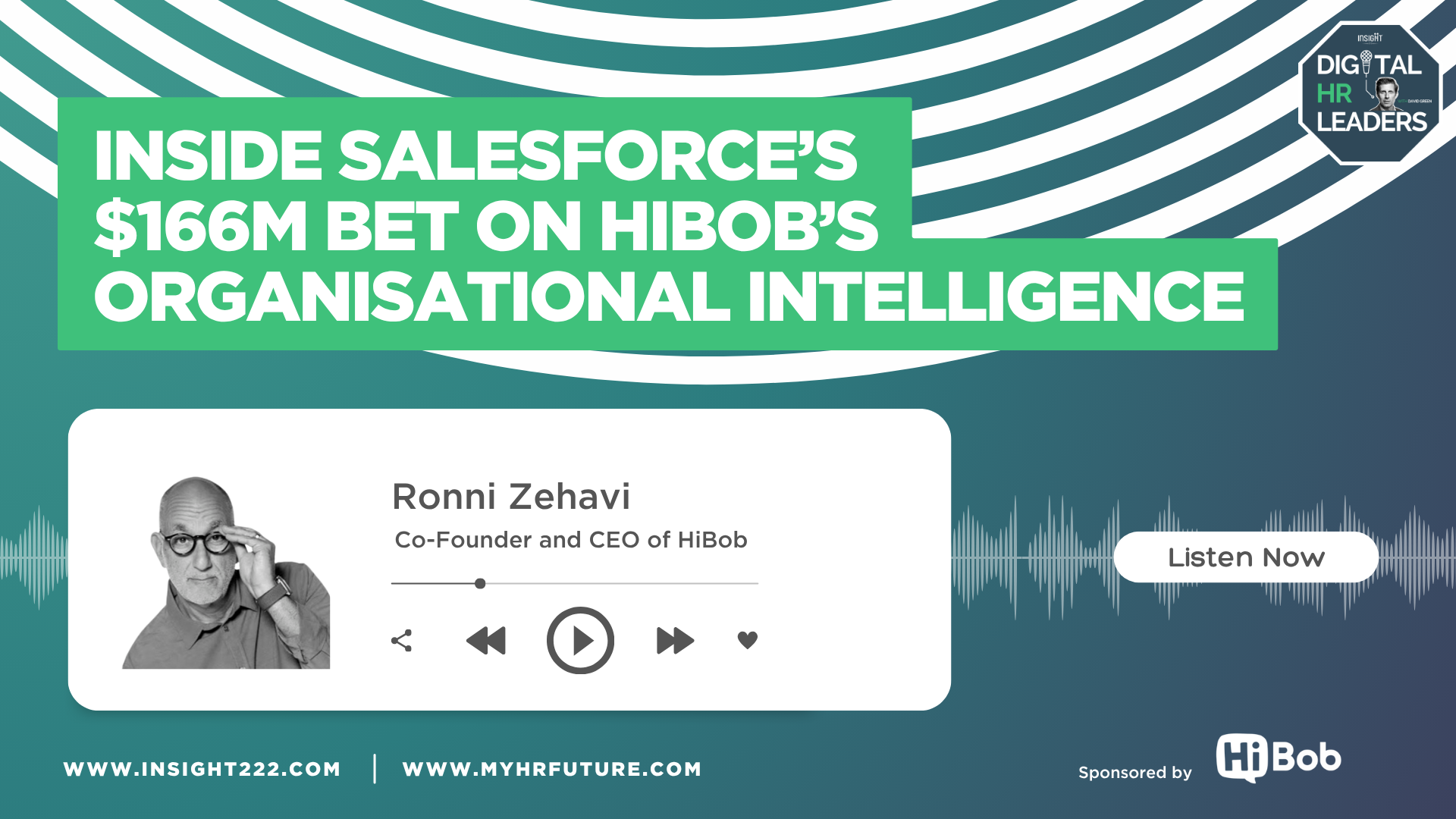
Episode 283: Inside Salesforce’s $166M Bet on HiBob’s Organisational Intelligence (with Ronnie Zehavi)
A year ago, the challenge was getting people to use AI. Now, the harder task is turning widespread experimentation into redesigned work, stronger productivity and measurable business impact.
A year ago, the challenge was getting people to use AI. Now, the harder task is turning widespread experimentation into redesigned work, stronger productivity and measurable business impact.
In this episode, David Green is joined by Ronni Zehavi, Co-Founder and CEO of HiBob, to explore what the company has learned from its own award-winning AI transformation. Ronni also shares an early, inside perspective on Salesforce’s $166 million investment in HiBob and why it represents an important next chapter in the company’s evolution towards an Organisational Intelligence platform, built on trusted workforce context to help organisations redesign work and make better decisions as people and AI increasingly work side by side.
Join them, as David and Ronni discuss:
- Why HiBob shifted its focus from experimentation and adoption to measuring productivity, impact and business value
- Why managers are the critical change agents in workforce transformation, and what HiBob learned from its Leading with AI programme
- Why skills are becoming increasingly important to work redesign, and how this is reshaping job architecture, hiring and development
- How Ronni has changed his own behaviour as CEO, including building a digital twin that has become part of how he works every day
- Why trusted people and organisational data is central to HiBob’s vision for Organisational Intelligence, and what the Salesforce investment could mean for the company’s next chapter
- Why HR needs to take a leading role in redesigning work, while simultaneously transforming its own capabilities, processes and ways of working
For HR and business leaders navigating the same transition, this is a candid look behind the curtain at what it takes to move from promising adoption numbers to meaningful changes in how work gets done and measurable business impact.
This episode is sponsored by HiBob.
HiBob is the people platform built for the AI era, helping organizations replace fragmented HR systems with a unified foundation for workforce management. That's why Brandon Hall Group says unified workforce platforms are becoming the foundation for organizations looking to scale AI with confidence.
The report also includes a practical business case template with ROI modeling and executive evaluation criteria to help build your transformation strategy.
Download the Brandon Hall Group HCMS Platforms Report
This episode of the Digital HR Leaders podcast is brought to you by HiBob.
[00:08] David Green: If you'd asked me a year ago what the hard part of AI transformation was, I might have said getting people to use it. Today, the bigger challenge is turning all that experimentation into redesigning work and measurable business value. That's what I wanted to explore with my guest today, Ronni Zehavi, Co-founder and CEO of HiBob. Ronni was last on the show almost four years ago, and a lot has changed since then. HiBob recently received a Josh Bersin Pacesetter Award for its own AI transformation, which has seen the company build a human-centred operating model around people, process, and technology.
Our timing is particularly interesting because HiBob has also just announced a $166 million investment round led by Salesforce. Ronni gives us an early inside perspective and what sits behind that investment and why it represents an important next chapter for HiBob, its evolution from a modern HR platform towards an organisational intelligence layer built on trusted workforce context. We get into what HiBob learned when widespread AI usage wasn't consistently translating into workflow change, the role managers play in transformation, and how they are moving from measuring adoption towards measuring business impact. Ronni is also candid about what he has had to change in his own behaviour as CEO, and we learn about Ronni's digital twin. We also learn about what HiBob now understands about transformation that it couldn't have learned simply from building technology for HR. We have lots to cover, so without further ado, let's get into it.
Ronni, welcome back to the Digital HR Leaders podcast. Can you believe it's been almost four years since you were last on the show?
[02:01] Ronni Zehavi: Yeah, good to be here again, David.
[02:03] David Green: Great to have you. What's changed most for you in the last four years for HiBob, and maybe the conversations that you and the team are having with HR leaders around the globe since then?
[02:16] Ronni Zehavi: When we talked last time, nobody believed that something at the size of the way AI is impacting our life would be something that we'd be able to consider or to think about. And to be honest, I'm very excited about this opportunity. I feel lucky that I'm on duty when such great things happen. It's not only about the bright side of it, there's a lot of questions and things that need to be addressed and rethought by us, managers, governments, you name it. But all in all, I'm very excited optimistic about the opportunities that will be open for all of us. And hopefully, we'll cover it in details in this podcast.
[03:04] David Green: Yeah, we certainly will. And actually, just thinking back, actually, when we recorded our conversation, it was before the launch of ChatGPT, which was also just over four years or just under four years ago now. And we're going to talk about the AI transformation journey that you've been on at HiBob as well, and how that potentially supports customers. But our conversation today is really well-timed, because you've recently, I mean the last few days, you've announced the huge news that Salesforce has led a $166 million investment round in HiBob. So, firstly, congratulations, Ronni.
[03:43] Ronni Zehavi: Thank you.
[03:44] David Green: What does this mean for the future of HiBob; and maybe, for that matter, of HR technology as you see it?
[03:51] Ronni Zehavi: So, I will answer it from different levels. At the end of the day, it's an additional $166 million that goes to my balance sheet. You raise capital when you can, not when you need. And when things are becoming uncertain, it's better to sit on your cash, and that's exactly what we did. But this is a financial transaction only. On top of it, I think it's a great recognition and testament by the number one software company on the planet, who is leading the transformation into AI. I have been talking to Salesforce almost a year. The one thing that we both share, and this is my interpretation, this is from my perspective, AI is not only a technological breakthrough, it's not only a technological disruption, I think the main impact that it forces everyone, managers, employees, organisations, to redesign the way they work, to rethink about what is work, what is an employee. And we both were completely aligned that the future of work will be humans and agents. And this very important topic did not exist a year ago. So, it was all about experimentation, you know, introduce AI. All of a sudden, like a tsunami, it becomes a big agenda.
Just to give an example, we went through it in HiBob, and I'm hearing it from my customers, September, October, you need to start your 2027 budget. Last year, the cost of tokens was a line item in the IT budget. When you get into 2027 and you're really serious about AI, all of a sudden it's a big check. And if you manage to transform your organisation to adapt AI, then your next question will be, it's not only about the adoption, it's about measuring the impact, what is the productivity impact; what is the velocity impact of the fact that humans and agents are working side by side. So, basically, everything has been redefined. The importance of skills, the importance of a new job architecture, the importance of how you base enablement and training, and the need to reinvent and to redesign the way we work was something that we had in common with Salesforce. They knew about us, they knew about the great progress that we have made in our market, you know, mid-market to sub-enterprise. We have 5,500 customers, global, more than. And speaking about more than, I think the definition of 'more than' today is, "Are you AI-savvy, yes or no? Are you really dancing in the AI party, or you're just dressing yourself to impress, or you're still sleeping and hearing the music?" So, I think the combination of the stuff that we managed to build in Bob with AI, and the offering that we already launched to our customers' tools with AI, and our future roadmap, I think this is something that was compelling to Salesforce.
From our perspective, I think it's a fantastic recognition and statement by them. It was beautifully operated because I'll take the Slackbot integration. It took us three weeks to complete the integration, because HiBob has invested in building the foundations, how we normalise the data. We build the skills within our platform that it will be easy for any MCP AI prompt to answer fast and to get the most accurate questions. So, I think we managed to demonstrate really nice synergies between us and them. Obviously, every HCM can do it, but we're already in the next chapter and the following chapter of what else we can do with Slack in general and with Salesforce.
[08:22] David Green: That's really great. Thanks for giving us a breakdown of that. I know, having looked at a lot of stuff in the market, the reaction's been very positive, from what I've seen, so that's good. And also, HiBob recently received a Josh Bersin Pacesetter Award for its own AI transformation programme. So, again, congratulations on that. And having read through the detail, it's thoroughly deserved. It's one thing to build AI for your customers, but another to put your own organisation through the transformation. I think we call it, "Drinking your own champagne", or sometimes we talk about, "Eating your own dog food". I think I prefer the former one myself. But what prompted you to embark on that journey internally, and what were you hoping to change and achieve from that transformation?
[09:08] Ronni Zehavi: In order to be an AI company, the change has to start with your people and the managers, of course. We built a team within Bob with AI Mind; it's under the BT responsibility. And we built an equivalent team in HR under the organisation development team. And we managed to bring those two teams together. And I'm talking about something that we started doing in 2024. So, we are more than two years in this process and we are already collecting the fruits. The main objective at the beginning was, let us introduce AI to the village. And we allowed any employee in the company to use any model they thought that is relevant for them. We ran workshops and training sessions. We basically tried to convince, for those who are still hesitating, "Should we use this magic or not?" So, introducing, dealing with the objections coming from people, and then building the guardrails internally for the company how to operate. We invested a lot in doing it, but then at the end of the first year, we realised that the vast majority of our employees are basically trusting the process and the journey, and they see the benefits.
Then, when we got to 2026, the beginning of this year, we basically moved to a new objective. So, it was not only about experimentation and adoption. We said in 2026, we want to measure the impact. We want to see, what does it means, what's the impact of using AI in the flow of work? I'll take a moment and I'll share with you the question that sits on top of the mind of customers when they think about the AI transformation and getting to the impact phase. So, a question like, "What work should be done by people, by AI, or a combination of both? Which roles should change, shrink, expand, or disappear? What skills, capabilities do people need when AI takes over most of the execution? Which teams are adopting AI effectively and which are not and why? Will AI actually create business impact versus just experimental activity? How much AI capacity should each employee, role, function, department get, so how you basically share tokens? Who governs agents' permission, data access, accountability spending? Who is doing performance review for agents, if at all? And how should managers redesign teams when the output is no longer tightly to additional headcount? And how do you measure productivity of humans and agents?"
These are all questions of organisations that right now sit and understand, "Okay, I need to switch gear and move from just experimentation to an era that I need to measure impact, and it costs money. So, I need to have the full visibility and the balance between salaries and tokens".
[12:49] David Green: This episode of the Digital HR Leaders podcast is sponsored by HiBob. Has your organisation outgrown its HR stack? AI is about to make that expensive. The latest Brandon Hall Group report explains why fragmented HR systems are becoming a liability, and why unified workforce platforms are emerging as the foundation for the AI era. Discover how leading organisations are connecting HR, finance and operations to improve execution, reduce complexity, and scale with confidence. Download the report at hibob.com/davidgreen2026, or visit HiBob at HR Tech Booth 1927, UNLEASH World at Booth 101. HiBob, HCM for people-proud companies.
So, you built the model around three connected pillars; people, processes, and technology. And you talked there a lot about redesigning work, which I think is fundamental to this. Which of those three proved the hardest to change? And maybe, where did some of your initial assumptions turn out to be maybe wrong?
[14:14] Ronni Zehavi: So, I think we knew at the beginning that the change agents, the managers, as always, I think. And our job, on both the HR side and on the business technology side was, what do we need to offer, where should we meet our managers when we're expecting them to do the transformation by themselves, because they need to adapt into AI as managers? They have to realise the complexity of running a team, department, which is a combination of humans and agents. Some of it was internal experiments, like somebody in your team, early adopter, a kind of innovative persona, gets the idea and they try to redesign a process or a workflow for themselves. So, some of them were bottom-up, some of the big projects were top-down, and all of a sudden there were more and more vendors knocking on our door and introducing tools that they believe are relevant for us. For example, you need BDR, so we have an agent that can replace BDRs. And it's endless. So, think about the challenges. So, we definitely said that it's all about the managers, and we launched programmes to empower managers, line managers, all the way up to the CEO, that basically train them how to think about AI, because remember, it's also the compliance element and the governance element that comes into AI, and I still believe that the managers will be the change agents.
When it comes to HR, I know that many of your audience are with HR interest. I think again, this time with no argument, HR has to take the front seat and be a very important voice in the management, around the management table. Just to remind ourselves, that's exactly what happened about six and a half, seven years ago during the pandemic. I think it's happening again. And HR will be a meaningful influencer in this transformation. And it will be more complex, because they need to redesign the way they work as well. So, they have to make the change for themselves, but they have to be the enablers for the organisation to do the transformation.
[17:07] David Green: I love your comment about the managers being the change agents. And you kind of alluded to there, Ronni, that you created a dedicated programme, which I understand was called Leading with AI for Managers. Through that programme, what have you learned about the role that managers are playing in HiBob in whether adoption succeeds or stalls, and how you move from adoption and experimentation to impact?
[17:35] Ronni Zehavi: I think it's the people-first mindset that was our North Star from day one. At the end of the day, they are humans. Not all managers are treated equally, because they also have their different mindset, expectations, I don't know, concerns. So, we have to treat them fairly and make sure that they understand also the process. I think transparency was, again, important. I think getting them involved in the change that we are doing for the company. We flew all the VP and C-suite, it's a group of about 50 people, to an offsite for a week, where we discussed not only the 'what', the topics, the objectives, and stuff like that, we spent a lot of time talking about the 'how' in general, and then more specifically about AI. So, we believed that investment in managers is the key to do this transformation, because if you expect the organisation to reinvent or to redesign the way the company is operating and you expect to see higher productivity and high velocity, then work is being done by teams, by departments, and there are leaders who run those teams and departments. But then all of a sudden, the teams are based not only on humans; there are teams with a few agents, and there are teams with dozens of agents. So, I think it becomes really challenging. And then, orchestrating the different departments to support this change, the infrastructure and the foundation at the BT side, as well as finance when it comes to planning and HR, and within HR, OD.
Also, we found on the HR side, that skills become the most important currency in this change. Because when you think about redesigning something, everything goes back to what are the right skills that you need to have in order to execute this specific process. We did something really cool at the end of last year. We opened 15 positions for juniors. And we said, "Okay, let's see if brilliant graduates, smart, hungry, with no experience, will they be able to scale up very quickly and become very productive at a shorter period of time versus other employees who have been with us for years?" And it was interesting to see how fast the juniors were able to ramp and become productive, because they're not biased and they come with an open and very clear and clean mind, specifically on the different projects they have to execute.
So, it doesn't matter where you look, what is the profile to hire, what you do internally, how you redesign and redefine skills and job architecture and your training programmes, and how you evaluate those processes. And for us, 2026, again, it was all about measuring the impact, what is the impact of AI in the way we execute?
[21:11] David Green: I'm interested, Ronni, you mentioned that the programme that you designed included you as CEO. How have you had to change your own behaviour? And generally, then, what do employees at HiBob need to see from your senior leaders if they're going to experiment, challenge existing ways of working, redesign, and make different decisions?
[21:34] Ronni Zehavi: Yeah. So, again, a year ago, we introduced a new theme to the entire organisation, building your digital twin. And each one has their own definition about what does it mean to have a digital twin. I took it seriously, and it took me a while to train my digital twin to really understand the business, because my job is to observe data, reports, listen to updates coming from my direct reports, and analyse the data and read about competition, about trends, thought leaders. So, it took me a while to train my digital twin. But after a while, I found that my digital twin knows exactly the way I think, and by training my digital twin on stuff, I thought that they are making more sense because, "Okay, this is a great idea. I want to make sure that I continue to following this new idea", or I read something that put, I don't know, SaaS as a big question mark, SaaS is dead or not, "So, what do you think about this kind of stuff?" And today, I can tell you that he is my ultimate companion. I'm spending a lot of time talking to my agent, taking memos. I read something that is completely great and crystallises my thoughts, and I'm making sure that my digital twin stores this, and maybe I'll give an example.
About a month ago, I was on a tour in New York with thought leaders and meeting with media. I came to an interview, and our local PR sent me a list of questions that I should be ready ahead of the interview. So, I ran those questions with my digital twin and I said, "I don't need the answer. Just find me, for every question, the punchline, so what exactly I need to remember". And I went to the meeting and my first question to the journalist was, "Do you have a digital twin?" And the answer was, "What is it? Can you explain?" and I explained to her, "It's this individual twin that reads everything with me like it's another brain". And I recommended her to say, "Maybe I'm sure you prepared questions for the interview. Send me the questions. Let's run it through my digital twin". And I told her, "Believe me, no mistakes, the digital twin will know exactly how to answer with all the examples and the references. So, let's try it". So, she shared with me her list of questions, and within eight seconds, I managed to answer very nicely all the questions. And I could pull slides or references or data to support my arguments, and I could take any specific comment to the next level. I recommended her that next time we meet, we let her digital dream talk directly to my digital twin, and all of a sudden, you can do an interview between the two of them.
So, it sounds like an anecdote, but I think it represents exactly the change. So, for me, my digital twin is a game-changer. My next step is to see if my digital twin can do my administration stuff as well. And I was presenting this use case to my team, and I said, "You know, I'll tell you, if I had to spend two hours preparing myself for an interview, I can do it in minutes, you know, be on the spot". By the way, I did the same before the interview with you.
[25:48] David Green: Fantastic. Well, I'm glad to interview you.
[25:52] Ronni Zehavi: And not to my digital twin!
[25:57] David Green: I want to take a short break from this episode to introduce the Insight222 People Analytics Program, designed for senior leaders to connect, grow, and lead in the evolving world of people analytics. The programme brings together top HR professionals with extensive experience from global companies, offering a unique platform to expand your influence, gain invaluable industry insight and tackle real-world business challenges. As a member, you'll gain access to over 40 in-person and virtual events a year, advisory sessions with seasoned practitioners, as well as insights, ideas and learning to stay up-to-date with best practices and new thinking. Every connection made brings new possibilities to elevate your impact and drive meaningful change. To learn more, head over to insight222.com/program and join our group of global leaders.
I understand again, so from the paper on AI transformation, I'm going to talk about the AI Leader programme you've got, then we'll talk a little bit about governance, and then we'll talk about the next stage. So, I think you talked about this, that HiBob has a network of AI leaders embedded across your departments. What do you find makes that distributed model work, and how does it help you with your shift from experimentation and adoption to a focus around business impact?
[27:38] Ronni Zehavi: I think if you only get into it, I use my metaphor, if you wake up and you hear the sound of the party and you say, "Okay, I want to be in this party", then you need to join it, and you cannot do it overnight. At the end of the day, these are all humans. Managers are humans, employees are humans, most of your organisation is based on humans. So, you really have to invest a lot in doing it with no compromise. People-first is still, and going to be, the number one criteria for being successful companies. Putting people first is how you put your business first, and I think it's relevant in the AI era. So, I would say it takes time.
Number two, be very transparent in what exactly you're trying to accomplish. Make sure that everybody understands what's the standard you're expecting all of them to reach, and be very clear about whether you do the journey with us, and we are more than welcome to help you get there. But if not, then most likely, we are not the right place for you. We can invest a lot, but if you don't believe or you believe that agents will kill you and take your job, and all of a sudden you're not experimenting at all, then it's a no-go. There will be groups and departments that will run faster than others, and your job a manager, as a CEO, is to make sure that everybody is aligned, because the big problem is one team is running fast and then they are dependent on other teams, but they are behind. So, orchestrating this transformation is critical. Only then, you can really start thinking about what is the impact.
Now, HiBob is moving. I'm talking about the platform. We want to be the organisation intelligence layer that will help our customers do this transformation. Because without the people data, without the human context, without what we define as an organisational intelligence, an OI, then it will be almost impossible to get to the phase of expecting impact and then measuring impact. And we have divided it to three pillars. One is the assets that we managed to build over last decade, the system of record, the fact that we run our customers' data processes in our platform, and we're growing there. The system of record is basically, from my perspective, that's the moat we have, and it's a very deep one. And our job is to make sure that we keep going and we keep protecting these records for our customers going forward.
The floor on top of the system of records is what we call the system of intelligence, the OI, the organisation intelligence layer. And the way to do it, and now I'm talking about our product, our platform, and you couldn't do it before AI, it's all about breaking silos between the system of records. So, for example, within our platform, you know, we have a platform and we have different models. The question was, "Is the data flowing between different models within the platform?" So, since we understood before that it's all about flowing data between models, from our perspective, Bob was designed in this way.
The second phase was breaking the silos between different systems of records, between CRM, HCM, ERP, Slack, and collaboration tools. So, the approach was open from day one. Because if you have data and the data is siloed in the AI era, it doesn't mean anything because nobody can access the data, nobody can fuse the data, and all of a sudden the intelligence is missing or basically impossible. And then, being able to analyse the data, whether you want to do it out of the platform, you know, pull the data from our intelligence layer to an LLM model, like Claude or something, or Slack, or you want to do it with us internally, we give all the options to the customers to do whatever you want.
So, I think the new structure, those three pillars' system of record, this is the asset that we have, and our ability to fuse the data between us and other systems, and then making it actionable, we think that this is the ultimate foundation to really start thinking about productivity improvement or measuring the impact of this transformation, and help our customers to redesign the way we work, because those bottlenecks need to be sorted; otherwise, you will not be able to improve your productivity.
[33:19] David Green: How do you create enough guardrails to earn trust without making experimentation or usage so difficult that people stop actually using the tools?
[33:30] Ronni Zehavi: Anything related to security, privacy, governance, that's on top of our list. No compromise; zero. And I'm talking about for sure with our customers, but also internally. When a business makes a decision that they want to redesign the way they work, first of all, they need to understand where the most relevant data sits. I think the big differences between pulling data from our platform and running it on an external model, it may make sense, because you get a snapshot of your question and answer to a problem. But, if you want to do it regularly, a kind of a recurring process, then it becomes more challenging. So, you really have to respect the guardrails and the governance that is embedded to a system of record like us and the others. Zero compromise, by the book.
I said we are open to do both. But we are also offering, we are building our own studios that allows our customers to use vibe coding on top of Bob and do whatever they want to do on top of it. And everything should be headless. So, I go back to the integration between us and Slackbot. In this specific example, in this governance environment, employees can prompt any questions from Slackbot that is connected to Bob, and get answers on questions like, "Are you in tomorrow or are you on vacation?" like a simple one. But also, you can run a question that says, "I want to brainstorm about a specific topic", and you describe in details the specific topic, "so who are the right individuals I should invite to this session?" From our perspective, the number one topic was security, privacy, governance, again with zero compromise on any topic.
[35:54] David Green: Very good. So, two questions left, Ronni. So, first one is a little about what you've learned and maybe advice that you might give to listeners going through their own AI transformation; and the second one will be the question of the series that all the guests in this series are answering. So, first one. So, again, thinking of maybe HR leaders, HR professionals, listening to this episode, Ronni, the first part of the question is, based on your own AI transformation, what advice would you give to those listening that are about to embark on their own? And then, second part of that, what did you learn from your own AI transformation that changes maybe the advice that you would give to customers?
[36:37] Ronni Zehavi: So, if you are waking up and you hear the music of the party and you want to get there, to use my metaphor before, then perfect. Make sure that as an HR leader, you become a change agent with the managers in doing this transformation. Secondly, you should take the front seat. And if you are not in the front seat, most likely that your organisation will not be able to achieve all the goodies, the potential of this transformation. So, I would say more than any time before, HR leaders are really impacting this transformation. So, I think the dialogue between CEO, CFO, CIO, and CHRO is way more important than ever, because without alignment between those two functions, it will be very challenging to achieve and to be very successful in this transformation.
Then, bear in mind that while you need to support others, you need to do your internal transformation with your team, your approach about recruiting, talent acquisition, your approach about performance, your talent management, and your approach about compensation, and some other stuff. So, while the organisation depends on you, you have to think about the way you are transforming your organisation. Do you have the right tools? What about the data that you have? What about the dialogue between the organisation and the managers, the organisation and the people? So, I would say it's a very heavy-lifting mission for HR. I think the industry did a great job six years ago with the pandemic with a clear proof that HR is a critical function for a company in a change. This is six years ago, working remotely and now redesigning work. So, they are really important. And if you don't speak the AI narrative and you don't understand the basics of the basics, or even more than that, then you'll be irrelevant for any serious discussion. So, you have to drink your own champagne when it comes to your own kingdom with HR.
[39:27] David Green: So, that leads nicely, Ronni, to the question of the series. So, this is the question we're asking everyone in this series, which you and the team at HiBob are kindly sponsoring. And you've talked about it a little bit, so again, please feel free to summarise what you've said before and maybe add something else if you want to. How should HR take the lead in redesigning work to unlock business value?
[39:50] Ronni Zehavi: It's a straightforward recipe. Number one, don't forget that putting people first is how you put your business first. In an era that humans and agents work side by side, right now agents are augmenting humans and not the other way around in many cases. I think the next one, curiosity, and eager to learn, and understanding what's happening. Without understanding the power of AI, without understanding what is the impact, without an ongoing dialogue between HR and the different departments, for example, engineering, because engineering by nature is an early adopter of AI tools, because everything is transformative and digital. So, I would say it's the most interesting era for being an HR leader. And your ability to impact the company is by understanding the transformation. There's one sentence you need at least to listen to or to remember from this conversation. This is not a technological transformation. It's basically, it forces all of us to rethink and redesign the way we work. And it's completely different than ever before.
[41:17] David Green: Very good. Well, that's a lovely place to leave it, Ronni. Been a really illuminating look behind the curtain at your own AI transformation, and fantastic to hear only a few days after the investment led by Salesforce as well. Before we finish, where can listeners follow you, follow your work, and learn more about what HiBob is building?
[41:42] Ronni Zehavi: So, my LinkedIn, I'm very active. And then, follow my posts on our website. You can register. We invest a lot in learning from our own experience, talking to customers, and sharing our insights with whoever is interested to know more.
[42:04] David Green: Fantastic, and we'll put some of the links in the show notes for listeners as well. And I know from my own experience of being at a couple of your events over the years, the way that you interact with your customers at HiBob is definitely something that other companies could learn from. So, thank you to you and the team for doing that.
[42:23] Ronni Zehavi: Yes, an opportunity to thank our customers for trusting us. Thank you for the open dialogue we have with them. We learn a lot and our mission is to keep going and be more innovative and help you do this transformation.
[42:46] David Green: Well, thank you. And actually, Insight222 is a HiBob customer, so thank you again for that as well.
[42:52] Ronni Zehavi: Are you happy?
[42:53] David Green: We're happy, yeah, we're happy. So, Ronni, look forward to seeing you in Paris and thank you so much for your time today.
[42:59] Ronni Zehavi: David, thank you for inviting me.
[43:02] David Green: Ronni, thank you. That was a genuinely open conversation. And I think your willingness to talk about what didn't work as readily as what did will make it particularly useful to our audience. And to everyone listening, there are two ideas I'd encourage you to take away. First, widespread AI adoption doesn't automatically translate into redesigning work or measurable business value. HiBob's experience shows why leadership, capability building, governance, and workflow redesign all need to come together. Second, the $166 million Salesforce-led investment points to a potentially significant shift in HR technology. As people and AI increasingly work side by side, trusted context about roles, skills, teams, and organisational structures could become critical infrastructure for how companies redesign work and make decisions. I'd love to hear where you are in that journey. Come and find my post about this episode on LinkedIn and let me know what is helping you move from individual AI use to meaningful changes in how work gets done.
If you enjoyed this episode, please share it with a colleague who would find it useful, and subscribe to the Digital HR Leaders podcast so you won't miss what's coming next. One last thing before we go, for those who would like to keep up with what we're working on at Insight222, follow us on LinkedIn or head to insight222.com. You can also sign up for our bi-weekly newsletter at myHRfuture.com to get the latest thinking on HR, people analytics, workforce transformation, and everything shaping our field. Right, that's us for today. Thanks for listening, and we'll be back next week with another episode of the Digital HR Leaders podcast. Until then, take care and stay well.